André Perugia: A Design Legend Unveiled
October 2025 to April 2027
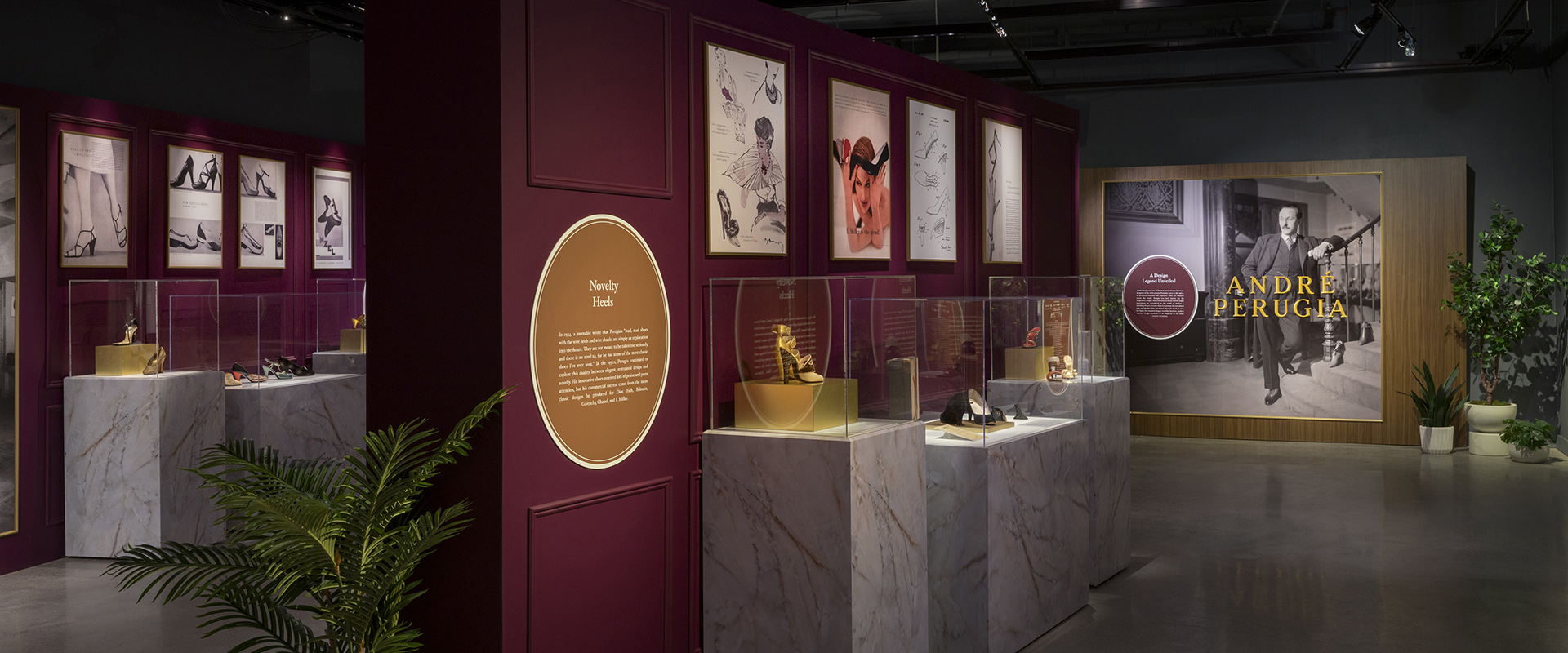
The Bata Shoe Museum explores the work of one of the most significant and under-researched footwear designers of the 20th century, André Perugia. A pioneering Italian-French shoe designer, André Perugia (1893-1977) is known for his architecturally innovative and technically masterful footwear designs. From his first boutique in Nice in the early 1920s, he revolutionized luxury footwear, creating shoes for fashion houses like Dior and Schiaparelli, as well as for celebrity clients including Josephine Baker, Mistinguette, and Princess Lillian of Belgium. His work is preserved in major museum collections worldwide.
Throughout the run of the exhibit, over 95 examples of the designer’s work dating from the 1920s through the 1960s, will be featured; shoes from contemporary designers inspired by his vision will also be on display. This exhibition will highlight the historical importance of Perugia’s work, contextualizing it within the larger framework of fashion across the decades. It will explore some of his most important innovations, including Perugia’s contribution to the development of the articulated sole and the stiletto heel.
André Perugia is curated by Nishi Bassi and includes objects from the BSM collection, and generous loans from Musée de la chaussure Romans-sur-Isère and Fondation Azzedine Alaia.
 EXHIBITION HIGHLIGHTS
Rhinestone Shoe
In the early 1920s, André Perugia did something
that no shoemaker had done before; he designed
women’s evening shoes with uppers made entirely
of glittering rhinestones. Newspapers and fashion
magazines showered him with praise for this
achievement, with one journalist writing, “Perugia
has achieved the height of fantastic good taste” with
these shoes. This brilliant, jewel-like pair, which likely
dates from the mid to late 1920s, is representative of
how Perugia approached design throughout his career:
with inventiveness and luxury in mind.
EXHIBITION HIGHLIGHTS
Rhinestone Shoe
In the early 1920s, André Perugia did something
that no shoemaker had done before; he designed
women’s evening shoes with uppers made entirely
of glittering rhinestones. Newspapers and fashion
magazines showered him with praise for this
achievement, with one journalist writing, “Perugia
has achieved the height of fantastic good taste” with
these shoes. This brilliant, jewel-like pair, which likely
dates from the mid to late 1920s, is representative of
how Perugia approached design throughout his career:
with inventiveness and luxury in mind.
Collection of Musée de la Chaussure
Mask Shoe
Perugia’s ‘mask’ shoe is one of his most recognizable,
and often copied, designs. He first released this model
in 1923, and then returned to this design multiple
times throughout his career. Inspired by Venetian
masks, this mule is representative of the novelty
and playfulness that Perugia would increasingly
engage with as his career progressed. This example
is made of bronzed lizard skin and features gilded heels.
Collection of Musée de la Chaussure
Embroidered Gold
This pair of shoes features vivid turquoise and red embroidery. Against the shiny gold leather of the upper, the shoes are reminiscent of ancient Egyptian material culture, which inspired many designers during the 1920s. What makes this pair of sandals particularly unique is the thin turquoise bands at the base of both heels; this was a special feature of many of Perugia’s designs from this decade. It was often Perugia’s special attention to detail that set his work apart from that of his contemporaries.
Collection of Bata Shoe Museum
Red Mule
In the 1950s, Perugia designed footwear that had the visible outline or impression of the wearer’s toes. There are examples of historic French and Dutch clogs which feature carved feet in them, but Perugia was the first luxury footwear designer to make trompe l’oeil toes fashionable. This motif is one of Perugia’s most imitated, and may have inspired footwear by Vivienne Westwood, Jeffrey Campbell, and Schiaparelli in recent years.
Collection of Musée de la Chaussure
Blade Heel
In 1951, Perugia revolutionized footwear design by
creating sandals with steel shanks, and thin steel heels,
which Harper’s Bazaar described as looking “like diamond needles.” They were unlike any other shoe produced in
the 1950s and were celebrated by Vogue as “the most spectacular shoe idea.” The technology and innovation used to create the “the blade heel” set the stage for the development of the stiletto later in the decade.
Collection of Musée de la Chaussure
Gold Boot
Throughout his career, Perugia produced footwear for notable fashion houses including Dior, Givenchy, and Paquin. Arguably, his most creative partnership was with surrealist fashion designer Elsa Schiaparelli. Through his work with Schiaparelli, Perugia played with form and height, creating glamorous wedges, platform heels, wrap around sandals, and ankle boots. This shiny gold boot from the late 1930s is both modern and historical. The button closures reference 19th century women’s footwear, and the scalloped topline adds a more contemporary art deco twist. Perugia once remarked that his work with Schiaparelli “inspired some of his most successful ideas.”
Collection of Musée de la Chaussure
Purchase tickets through ShowPass
BUY NOW
Media Partners
BSM programming events have been financially assisted by the Ontario Cultural Attractions Fund, a program of the Government of Ontario through the Ministry of Tourism, Culture and Sport.
Rough & Ready: A History of the Cowboy Boot
May 2025 – October 2026
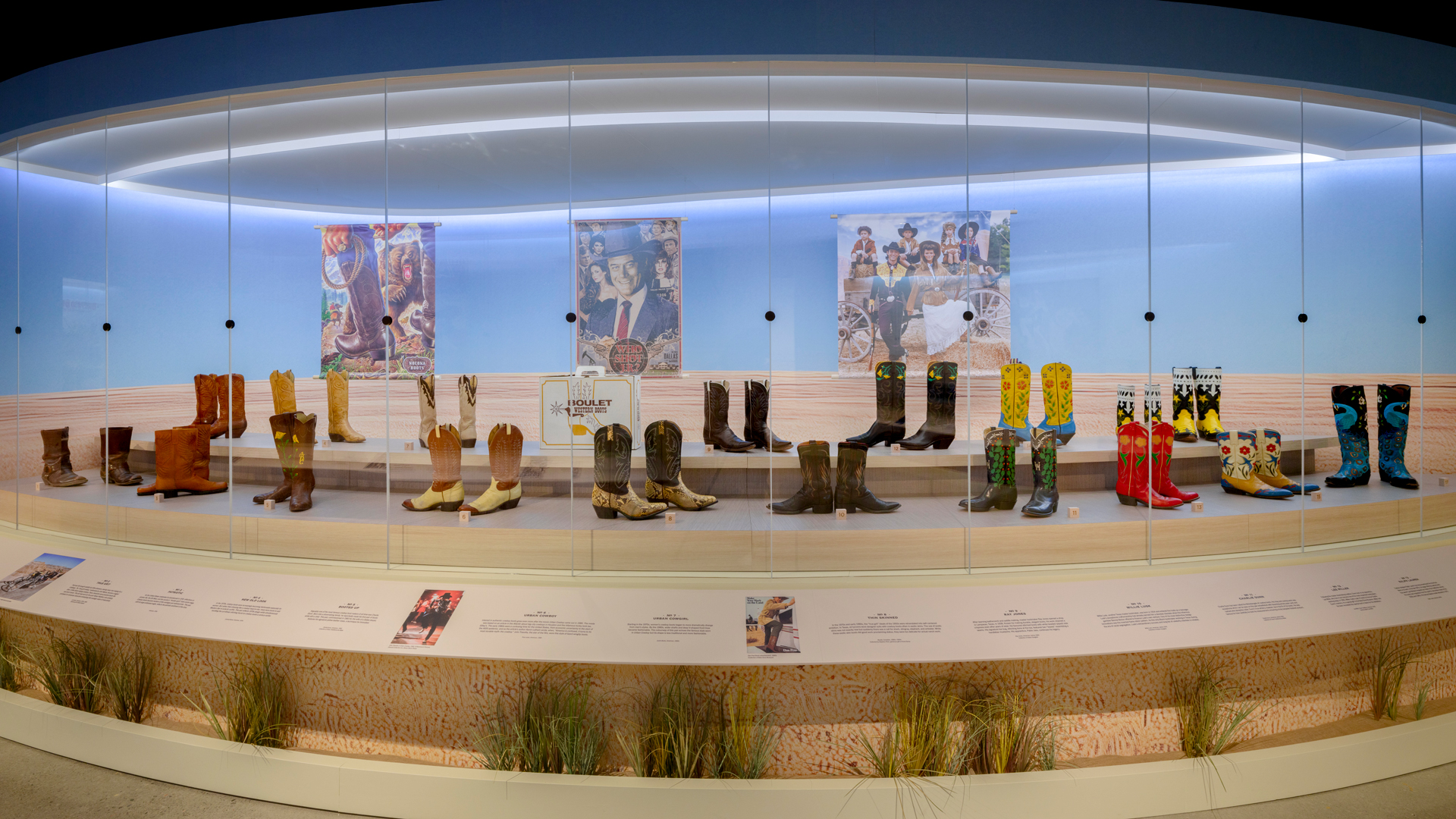
The story of the cowboy boot is steeped in history and legend and is neither simple nor straightforward. Since their invention in the late nineteenth century, cowboy boots have embodied contradiction. They have symbolized labor and leisure, freedom and domination, tradition and reinvention. Cowboy boots were born out of industrialization yet refined through expert craftsmanship, they have been used to both celebrate individualism and forge cultural cohesion. They were central to the closing of the West, yet endure as emblems of freedom and wide-open spaces. Over time, cowboy boots have signaled power and privilege as well as resistance and reclamation. Whether worn in the saddle, on screen, or in the streets, cowboy boots remain a cultural touchstone, embodying both tradition and transformation in a constantly changing world.
Rough & Ready is curated by Elizabeth Semmelhack, including objects and artworks from the BSM collection and 13 lenders. Lenders include: Adam Goeglein, Autry Museum of the American West, Barry Ace, Erik Semmelhack, Flora Knight, The Glenbow-Alberta Institute, Jamie Cuevas Nudie, Lee Miller, Lisa Sorrell, Lucchese Bootmaker, Orville Peck, Sarah Madeleine T. Guerin, and Tony Benattar.
EXHIBITION HIGHLIGHTS
Early Heels
Heels, worn in Iran from as early as the 10th century, were designed to secure the foot in the stirrup. Europeans adopted heels at the turn of the 17th century, a key innovation that would later influence cowboy boot design.
Persian, 18th or early 19th century
Canadian Made
These custom-made cowboy boots were worn by Margaret Brazeau (née Fry) in Calgary Stampede parades in the early 1920s. They are decorated with the popular tulip design favoured by cowboy film star Tom Mix.
Riley & McCormick Co. Ltd, Canadian, 1922 – 1924. Collection of the Glenbow
Gene Autry
Actor and musician Gene Autry loved boots. A newspaper article from 1938 reported that “He has just one little mania that he indulges. He can’t resist buying cowboy boots. He has a new pair made every time he sees some he likes. He has a dozen pairs.”
Olsen-Stelzer, American, mid-1930s. Collection of the Autry Museum of the American West
Peacocking
Rocketbusters Boots was founded by Marty Snortum in 1989 to revive vintage styles. When designer Nevena Christi married Snortum, Rocketbuster boots became even more elaborate. This bespoke pair was made for Don Knobler, the eccentric Dallas Mavericks superfan, who famously wore his custom cowboy boots courtside to games.
Rocketbusters Boots, American, 2010s
Orville Peck
This pair of bespoke boots was made for Canadian country-western superstar Orville Peck by bootmaker Emily Boksenbaum who trained under one of the first women bootmakers, Deana McGuffin. These boots complement Peck’s unapologetic persona and bold interpretation of the Western aesthetic.
Underhill Studio, In the Dead of Night You Say its Time to Ride, American, 2024. Collection of Orville Peck
Purchase tickets through ShowPass
BUY NOW
Media Partners
BSM programming events have been financially assisted by the Ontario Cultural Attractions Fund, a program of the Government of Ontario through the Ministry of Tourism, Culture and Sport.
View press release.
Art/Wear: Sneakers x Artists
October 03, 2024 – April 6, 2026
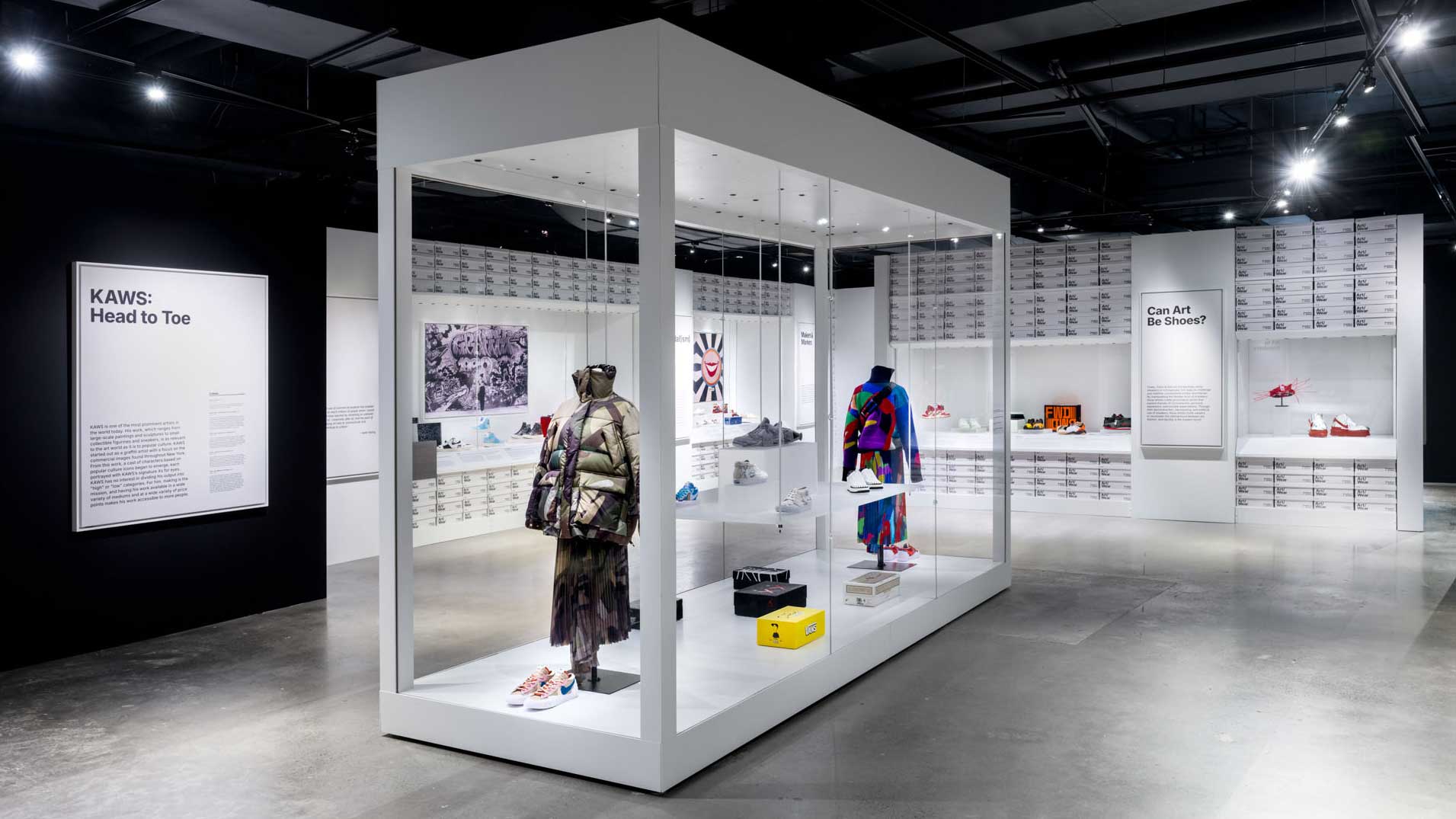
“What is art?” This question has sparked debate for centuries, and today, the boundaries of what defines art are being pushed further than ever. One significant shift is the growing trend of artists engaging in commercial collaborations, particularly with sneaker brands. These collaborations blur the lines between art, fashion, and commerce, offering consumers the opportunity to buy and wear creations by some of the most revered figures in the art world. Many of these sneakers are also finding their place within traditional art spaces, such as museums and auction houses, where their rarity has elevated them to a status similar to limited edition artist prints. The cultural significance of these artist-sneaker collaborations is contributing to the ongoing discussion of what defines art today.
Many artists are increasingly using sneakers in conceptually rich ways to challenge and redefine conventional artistic boundaries. By manipulating the familiar form of sneakers, these artists create provocative works that explore themes of consumerism, personal expression, and societal expectations. Through their deconstruction, repurposing, and political use of sneakers, these artists invite viewers to reconsider the intersections between art, fashion, and identity in the modern world.
Art/Wear: Sneakers and Artists asks why artists are drawn to working on/with sneakers and why so many of us are interested in wearing these pieces. It also explores the longstanding divide in Western thought between art and fashion, ultimately questioning if and how our collective definitions of art are shifting. Topics explored include: a history of sneakers as canvases, graffiti artists and sneakers, and artist collabs, and the rise of customization as its own art form.
Artists on view: Aaron Fowler, Alife, Andrew Mania, Bryant Giles, Cey Adams, Damien Hirst, Daniel Arsham, Dave White, ESPO, Futura, Eric Haze, Hebru Brantley, Javier Calleja, Jean-Michel Basquiat, Judi Werthein, Kate Knudsen, KAWS, Keith Haring, Kenzo Minami, Mache, Michael Lau, MSCHF, Peter Max, Ruohan Wang, Shantell Martin, Stash, Takashi Murakami, Tom Sachs, Vicky Vuong, and Virgil Abloh.
EXHIBITION HIGHLIGHTS
Peter Max x Randy Shoes sneakers, c. 1969–1971
In the late 60s / early 70s, artist Peter Max was arguably the most influential artist in the Western world. His psychedelic artwork was uplifting, counterculture in feel, and yet extremely marketable. By 1969, he had over 50 commercial licensing agreements. This pair of high tops features Max’s style, including his signature smiling mouth.
Daniel Arsham x adidas Originals New York Futurecraft 4D, 2018
For his Past, Present, Future collaboration with adidas, renowned artist Daniel Arsham explored how present objects embody ideas of the past while destined to be transformed by the future. This sneaker features a 3D printed sole, branding exposed only by blue light, a specially designed box that, once opened, cannot be closed again, and included a pair of gloves for handling the artifact.
KAWS x DC Shoes, 2002
KAWS, is one of the most prominent artists in the world today. His work which started as graffiti in New York and now ranges from large-scale paintings and sculptures to small figurines and sneakers, is as relevant to the art world as it is to popular culture. One of KAWS’s earliest sneaker collabs was with DC Shoes in 2002 featuring his character Chum. Only a limited number of these sneakers were ever produced..
On loan from the artist
Ruohan Wang x Nike Blazer Mid 77 Flyleather, 2020
Renowned for her use of colour, commitment to protecting the planet, as well as the concept of “Time and Energy Transformation”, Ruohan Wang was invited by Nike in 2020 to collaborate on three sneakers made using their new recycled Flyleather. Wang incorporated the Chinese phrases ⾃然循环 (natural circulation) and ⼒量与爱 (power and love) into the design to convey that the Earth belongs to everyone and protecting it is a universal responsibility.
MSCHF BWD, 2023
Brooklyn-based artist collective MSCHF, pronounced “mischief”, constantly questions the validity of our ideas about art and consumerism through their sometimes controversial work. This BWD shoe is designed to be worn backwards. As their description states, “Life can only be understood backwards but must be lived forward. That’s why you need two pairs of shoes, one for living and one for understanding.”
Murakami x RTFKT x Nike Air Force 1 - Murakami DNA, 2024
Renowned Japanese artist Takashi Murakami began collaborating with RTFKT (pronounced “artifact”) in 2022 when they were acquired by Nike to create avatars and fashion in the Metaverse. Some of RTFKT’s creations are “forged”, meaning made physical for use in the real world, like this pair of sneakers, one of only 167 pairs ever made.
Keith Haring x Zara, 2024
One of the most famous artists and activists to emerge from the New York graffiti art scene, Haring was quickly embraced by the art world. He used his notoriety to bring attention to the AIDS epidemic that would eventually take his life in 1990. Since his death, his estate has licensed his art for various uses including this pair of children’s sneakers. All proceeds support the granting initiatives of the Keith Haring Foundation.
Purchase tickets through ShowPass
BUY NOW
Media Partners
All About Shoes
Footwear Through the Ages
Take a fascinating journey and experience the many facets of footwear: its evolution and symbolism through the ages, the methods and materials of its manufacture and its place in our imaginations.
The BSM’s flagship exhibition, All About Shoes: Footwear Through the Ages, is a voyage through four and a half millennia of shoes. As well as presenting an engaging overview of the history of footwear, All About Shoes also explores the wider context of our fascinating collection.
Semi-Permanent Exhibition
Behind the Scenes: A Glimpse into Artefact Storage
The Bata Shoe Museum currently holds nearly 15,000 shoes and related artefacts, spanning 4,500 years of footwear history. This extraordinary collection is central to the museum’s mission and enables us to mount dynamic and changing exhibitions. With only four percent of the collection typically on view at any given time, the rest of our artifacts are maintained in two specially-designed subterranean vaults, which keep the collection safe and secure while facilitating research and conservation by staff and visiting scholars. This section of the All About Shoes gives you a peek into this seldom-seen aspect of the museum’s work.
EXHIBITION HIGHLIGHTS
Cartonnage
Egypt, Ptolemaic Period, 300 B.C.E - 1 C.E
The surfaced of this rare piece of Egyptian cartonnage has been painted to draw viewer's attention to the feet and sandals of the deceased. The underside features painted sandals soles.
Mojaris
Indian, c. 1840
This pair of saffron coloured mojaris was worn by a temple dancer in Rajasthan. They feature gold zardo embroidery and the jade beads and brass bells would have created a beautiful tinkling sound when the wearer danced.
Manchu
China, c. 1880
Manchu women were forbidden to have bound feet and instead wore high platform shoes that stilted their gait and allowed them to emulate the desirable shuffling ‘lotus walk’ of women with bound feet. Although the Manchu and the Han were distinct ethnic groups within China, they shared a similar artistic vocabulary, a fact attested to by the use of similar motifs such as the butterflies that decorate the uppers of these shoes.
Chopines
Italy, 16th century
Platform footwear called chopines were a staple of upper-class women's fashion in Italy and Spain in the 16th century. In Italy chopines were made of wood and worn hidden under long dresses, while in Spain they were made of cork, highly decorated and worn visible. These chopines share similarities with both Italian and Spanish styles and comes from a part of Italy ruled by the Spanish.soles.
Chestnut Crushing Clog
France, 1800 - 1900
This menacing looking clog was worn in the Haute Ardèches region of Auvergne, France in the 19th century for the innocent task of crushing chestnuts. The chestnut was an important source of source of food for both people and animals. These peasant work clogs were tools essential to food production in the 19th century but today are fodder for the imagination
MANOLO BLAHNIK
Spanish, 2014
Spanish designer Manolo Blahnik (1942 - ) has been dedicated to the art of shoemaking since the 1970s. His work is often inspired by the elegance of the past which he translates into objects of desire for the present. This pair of Locka’s was gifted to the museum by Mr. Blahnik in 2014. It remains one of his favourite shoes of that season.
Purchase tickets through ShowPass
BUY NOW
For media requests please contact
Sarah Power, Head of Communications & Marketing.
For image requests please contact a href=”mailto:alexandra.geropoulos@batashoemuseum.ca”>Alexandra Geropoulos, Collections Manager & Registrar<
Current Exhibitions
André Perugia
Opens Oct. 30, 2025
Learn More
Rough & Ready
A History of the Cowboy Boot
Learn More
Art/Wear
Sneakers x Artists
Learn More
All About Shoes
Footwear Through The Ages
Learn More
Traveling Exhibition
Future Now: Virtual Sneakers to Cutting Edge Kicks
Learn More
Online Exhibitions
Learn More
Past Exhibitions
Learn More
See Exhibition
Press Release