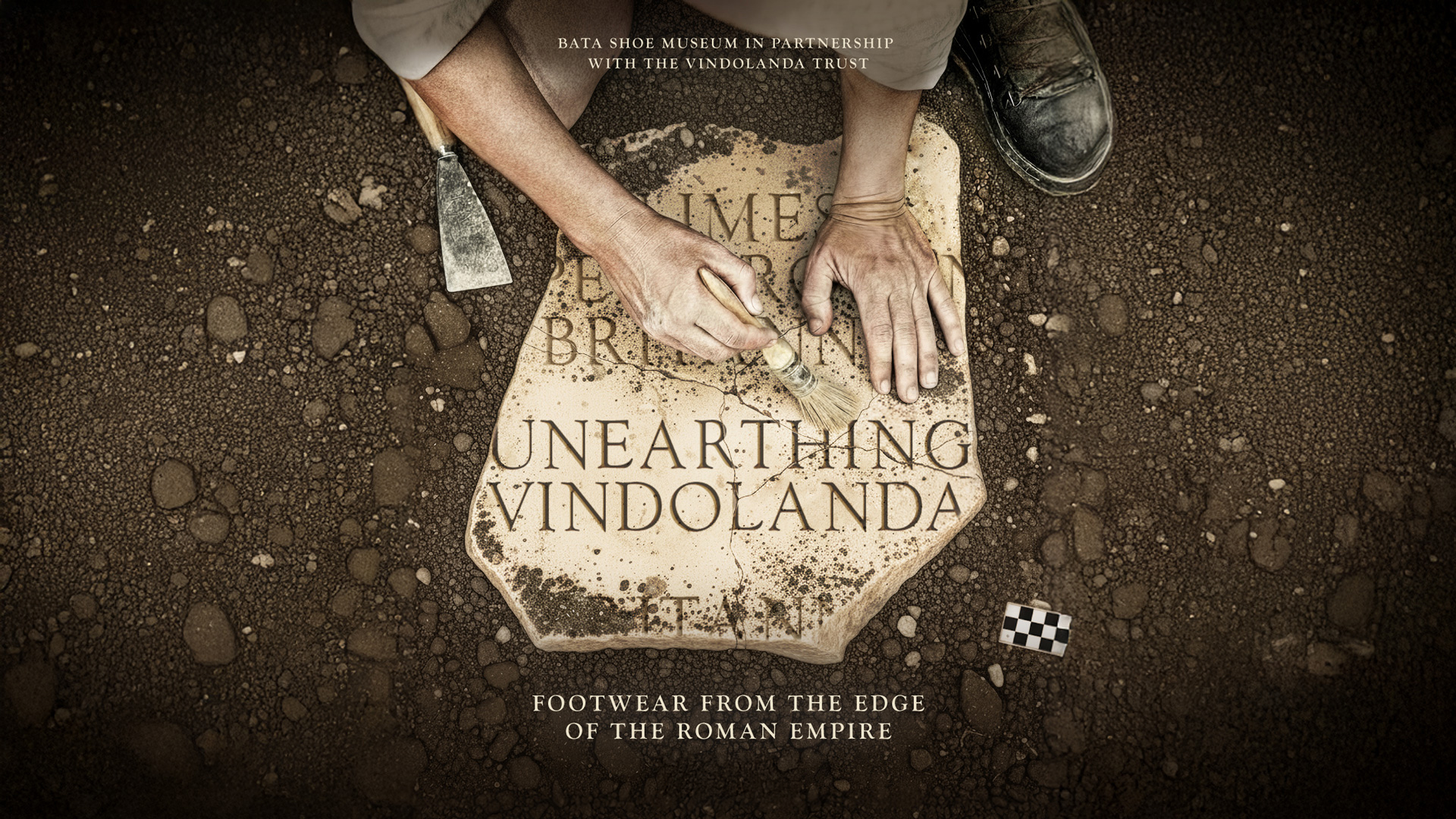
Unearthing Vindolanda: Footwear from the Edge of the Roman Empire
Opening May 7, 2026
Discover over 100 footwear-related artifacts from Vindolanda, a Roman auxiliary fort and settlement located just south of Hadrian’s Wall in Northumberland, England. On view for the first time ever in North America, these remarkable objects are part of the Frontiers of the Roman Empire UNESCO World Heritage Site which is renowned for its ongoing archaeological excavations providing unprecedented accounts of ancient life at the edge of the Roman Empire.
When archaeologists at Vindolanda began finding a wide variety of shoes, our understanding of who lived in Roman military forts and settlements was changed. Researchers had long thought that Roman military garrisons were the domain of men alone. However, the footwear unearthed at Vindolanda revealed a much more complex story as archeologists found the sandals of elite women, shoes worn by little children, as well as sturdy and practical military boots of soldiers. As excavation work continues, it is now clear that nearly 2000 years ago, a vibrant community surrounded the Roman military garrison that included men, women, and children in significant numbers. The shoes they wore offer us a rare and special glimpse into the lives they lived at the outermost edge of the Roman Empire.
Curated by Barbara Birley, Curator, Vindolanda Museum, and Elizabeth Greene, Associate Professor of Classics and Canada Research Chair at Western University. Coordinated by Elizabeth Semmelhack, Director & Senior Curator, Bata Shoe Museum, including objects from the Vindolanda Trust.
EXHIBITION HIGHLIGHTS
Children’s Shoe
A shoe worn by a child of around 10 to 12 years old. The stitching around the lace holes and
the wave pattern on the edges of the shoe provide
a decorative element to this otherwise everyday shoe. The hobnail pattern on the outer sole is a simple utilitarian configuration. Collection of Vindolanda Trust, Mid 2nd century CEBath Clog
A Roman footwear style popular for use in the bathhouse was the wooden clog raised on ‘stilts’.
This example was embellished with lines marking where the toes sat and the leather strap was decorated with a serrated edge and an incised geometric pattern.
Collection of Vindolanda Trust, ca. 140-180 CEMarching Boot
The most common type of footwear worn by soldiers is the ‘Fell Boot’ with leather uppers and a line of lace holes up the front edges. There are rarely any decorative elements added to this type of boot as it was designed to be utilitarian. Collection of Vindolanda Trust, ca. 100-105 CEHobnail Sole
The hobnails of this shoe are set in a decorative geometric pattern under the foot, another reminder that not all shoes were for the workday. This shoe also has a fringed edge on the upper portion, details that suggest it was used for leisure or off-duty time.
Collection of Vindolanda Trust, ca. 105-120 CEFishnet Military Boot
The uppers from this military boot are a style known as ‘fishnet’ because of the many small holes punched into the leather to create a decorative pattern. Further embellishment is found in the decorative shapes cut out near the lace holes and the serrated upper edge.
Collection of Vindolanda Trust, ca. 100-105 CE Media Partners
E-News Sign Up
The Bata Shoe Museum is located at 327 Bloor Street West, at the southwest corner of Bloor Street West and St. George.
By Transit
From the St. George subway station (on both the Bloor-Danforth and the Yonge-University lines), exit onto St. George Street. Turn left (walk south) for about 30 seconds and you’ll be at the northeast corner of Bloor Street West and St. George Street. From there, cross the road twice to reach the southwest corner of the intersection, and you’re at the Museum!
By Car
From Highway 401
Take the Avenue Road exit and go south to Bloor Street. Turn right onto Bloor Street and continue west to St. George Street. OR take the Bathurst Street exit and go south to Bloor Street. Turn left onto Bloor Street and continue east to St. George Street.
From the Queen Elizabeth Way (QEW)
Get onto the Gardiner Expressway and exit at Spadina Avenue. Proceed north on Spadina to Bloor Street. Then turn right onto Bloor Street and go east on Bloor to St. George Street.
Parking
Street parking and paid parking lots within walking distance of the Museum may be available. Possibilities include:
The Toronto Parking Authority’s Carpark 58, the Bloor-Bedford Garage: 9 Bedford Road, north of Bloor Street West and two blocks east of the Museum.
The Toronto Parking Authority’s Carpark 205: 465 Huron Street, north of Bloor Street West and one block west of the Museum
Search the Site
Info Modal Title
Info Modal Date
Modal event text.
Counting down to the opening of our newest exhibition, The Great Divide: Footwear in the Age of Enlightenment. Do you have your tickets yet?